
← Back to the list of articles

More Than Security: 5 Ways to Turn Video Surveillance Into Entertainment
People almost always buy cameras for safety reasons: to catch a thief, to settle a dispute, to see who smashed the shop window.
And yet a camera has another side that rarely comes to mind: it can be a source of entertainment. After all, what the camera shows can be interesting not only to your security team, but to your customers as well.
So how exactly can a surveillance system be put to work entertaining customers? Let’s look at five examples.
1 Live streaming
A live feed from your cameras is the simplest tool of the lot — and the most underrated. You aren’t inventing anything; you’re just opening up access to what the camera is filming anyway.
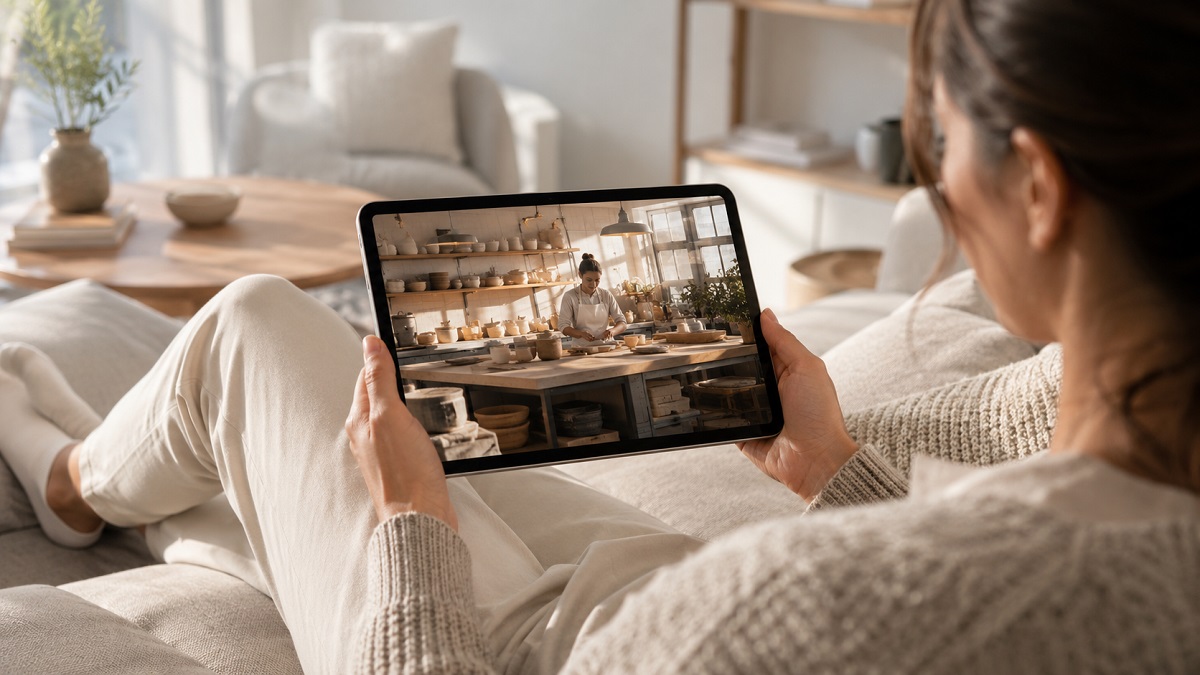
A live feed does a whole range of jobs, from image-building advertising to turning the unknown into something the customer can watch unfold.
a A stream embedded on your website
In China, when you buy an electric car, you’re given a link to a live stream from the factory floor so you can watch your own car being built. Instead of an anxious, empty wait, the buyer sees with their own eyes that things are moving along.
Construction companies rely on the same logic. In hard times, would-be buyers are wary of putting money into buildings still going up, afraid they’ll never be finished. Here, too, a surveillance camera saves the day: the stream shows that the machinery and the people are on site, working in an organized, uninterrupted way. That inspires confidence and draws in investment even when the going is tough.
In Russia, a well-known pizza chain invites you, once you’ve placed your order, to watch your pizza being made. In food service, a stream has a second effect as well: it answers the silent question that nags at everyone — whether the kitchen keeps to hygiene standards. This is the classic case where a picture is worth a thousand words, and a live video that answers those questions is worth a thousand pictures.
There’s one category where this works better than anywhere else: pet hotels, veterinary clinics, care homes, private nurseries and clubs for children. Here the customer is wrestling with a very specific fear — how is my pet, my relative, my child doing without me? Being able to check the stream at any moment lays that worry to rest once and for all, and it often turns out to be the deciding factor in the choice.
b Live streams on YouTube
In the age of streaming, watching someone else work has become entertainment in its own right. People spend hours watching bloggers and streamers train, tune cars, clean carpets, paint pictures or make music. There’s an appetite for that kind of content — and you already have the cameras and an interesting process to show.
For a business, this is a chance to stand out. Streaming your production line, your kitchen or your repair workshop takes no script, no camera operator and no editing. It runs on its own and gradually gathers an audience.
There’s also a way to use streams purely for the customer’s convenience. People often check city cameras to see the traffic or the weather, and you can present your own surveillance the same way: a post office shows there’s no queue. A café streams its dining room, and a guest can see the free tables before setting out. A laundromat shows how many machines are free. The customer gets an answer to an everyday question and saves some time, and you get a loyal customer for whom you’re simply convenient to deal with.
And of course, a live feed can carry genuinely entertaining content: the lives of pets and wild animals, the bird feeder outside the window, a plant growing in a pot on the sill, a DIY renovation taking shape. These “behind the glass” shows tend to have a surprisingly devoted audience and very long watch times, at zero cost to produce.
c Camera footage on a screen in the room
The third option needs no website, and no internet at all. A monitor in the waiting area is enough.
At a car repair shop, the customer nearly always has to wait. You could put up a TV with the usual channels — or you could show the feeds from the cameras in the service bays. The difference is fundamental: instead of unrelated content, the person sees that their car really is being worked on. The wait stops being irritating, because it’s filled with something.
This is where automatic camera switching works nicely. The cameras take turns, and it plays out like flipping channels: the view cuts away at the most interesting moment, and you find yourself wanting to wait for that angle to come back around. Simple mechanics, and it holds your attention.
2 Interactive rewards
Here the camera stops being an observer and becomes a participant. The guest does something, the system recognizes it, and something pleasant or surprising happens. It’s essentially a fairground attraction built into everyday life.
Face Detector (emotions). The “smile at the camera and get a discount” mechanic needs no explaining and works at the counter, at the entrance to a photo zone, in a kids’ room. A person smiles, gets a bonus and — more importantly — leaves with a good impression they’ll share.
Speech analytics. The module reacts to words and phrases you specify, so it’s easy to turn into a playful password. A guest says the code word and something happens: a sound plays, a light comes on, a door opens, a prize drops out. For escape rooms, themed bars and promo campaigns, it’s a ready-made mechanic your competitors aren’t using yet.
Age and gender recognition. The “guess my age” attraction is a familiar sight at trade shows and shopping malls, and it still hasn’t worn out its welcome. People argue with the system, test it on their friends and film the whole thing on their phones — which is exactly what you want.
Technically, all three run the same way: a detector fires and triggers a reaction. What happens next is up to your imagination, because the reactions in a chain fit together like building blocks.
3 A video to keep
A live feed shows the process in real time. But there’s another format too: the guest walks away with a finished clip about themselves.
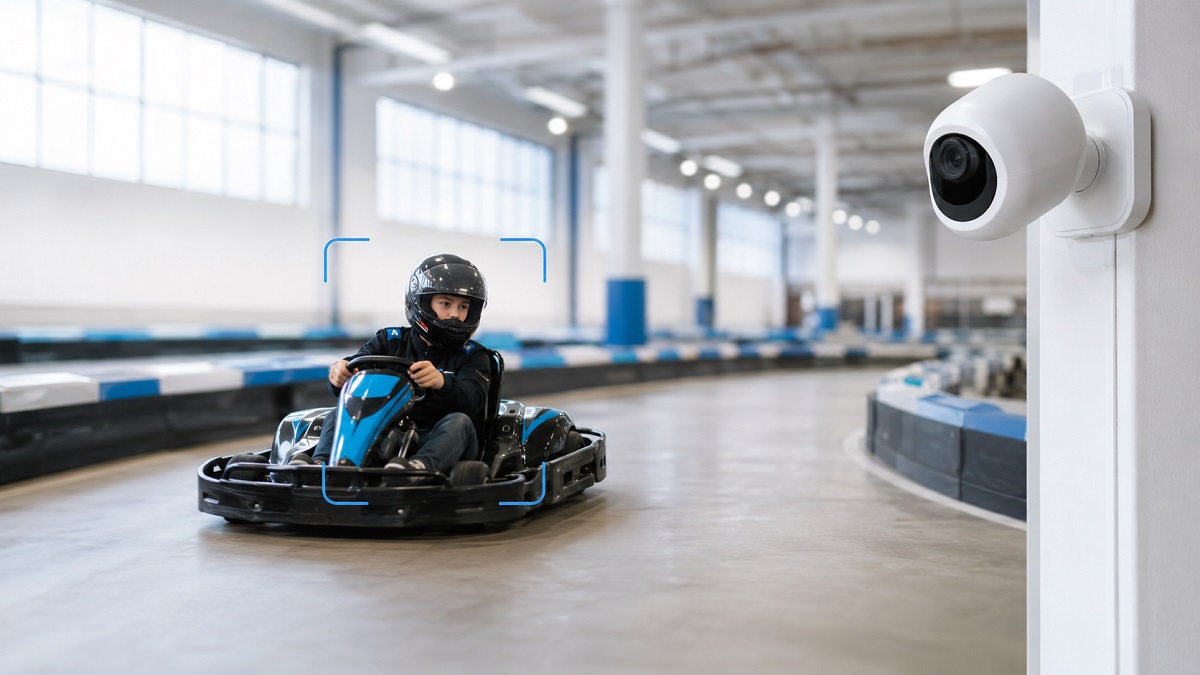
Tracking sports events. The system films a match or a race with no operator, keeping the play in frame on its own. Amateur football, karting, a tennis court — the club ends up with a recording of every match, and the players are happy to take it away, often for a fee.
Auto-tracking with a PTZ camera. The camera follows a person by itself, keeping them centered in the frame. A climbing wall, a trampoline park, a dance floor, an obstacle course — wherever you used to need a camera operator, a properly built chain of modules is now enough.
Time-lapse. Playing the archive back at speed turns hours into minutes. Setting up an exhibition stand, dressing a hall for a wedding, a whole day of an event, a flat renovated from start to finish. People watch clips like these all the way through, save them as keepsakes, post them on social media and forward them to friends.
Overlaying text, a logo and an image. The date, the name of the event and your logo right there in the frame. The clip is handed to guests already branded.
The whole point of this one is that the video keeps working after you’ve done nothing more. The person posts it themselves, tags the place, shows it to friends. You get advertising that your own customer shot and distributed for you.
4 The camera as a trigger: the space reacts to the guest
Where “Interactive rewards” asked the visitor to act deliberately, here it all happens by itself: the system notices behavior and changes the space around the person.
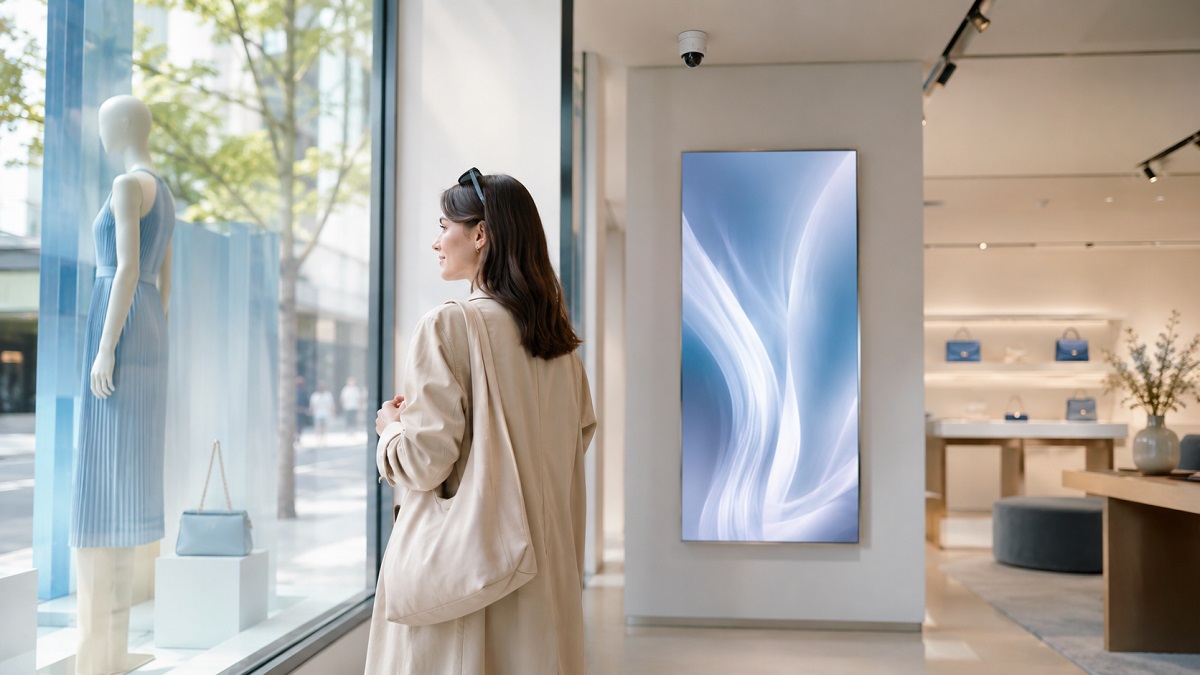
Lingering at a display. A loitering detector notices that a visitor has stood in one spot longer than usual, or eye-tracking reports that someone is looking at a premium product. That’s a signal of interest, and you can answer it: play a clip about that very product on the nearest screen, light up the display, call over an assistant. The advert is shown to someone who’s already interested, rather than to everyone at once.
Walking up to an exhibit. In a museum, a showroom or at an exhibition, a motion detector in the right zone is all it takes to switch on audio, lighting or a video sequence. The display comes alive as the visitor moves through it, and it feels like magic, even though the workings couldn’t be simpler.
A reward for luck. Color recognition lets you run promotions like “free coffee for anyone in red today.” The camera works out who qualifies on its own, the staff don’t have to check anything, and the guests feel appreciated thanks to an unexpected gift.
Scanning a code. QR-code recognition turns the camera into an automated authorization system. The guest has a code on them (on a badge or a cap, say), the system reads it and hands out a discount or a prize, or lets them into a restricted area. Nothing is required of the customer.
All four of these are put together on a single principle: a detector plus a reaction. The reaction can be a sound, a light, a message, a command to an external system or a clip launched on a screen — so the range of scenarios is limited more by imagination than by technology.
5 New wow-factor technologies
Some things still feel like a novelty simply because hardly anyone has seen them in the flesh. Those are the easiest to build an impression on.
The virtual fitting room. It lets you “try on” clothes from a catalogue without stepping into a fitting room. The feature is still in development and available on request, but the interest it draws says a lot: the sheer ability to see yourself in a new look almost instantly acts like a magnet on the shop floor.
AI Observer. This new module puts everything it sees in the frame into words and lays those descriptions right over the image. What you get is a ready-made entertainment format: an artificial intelligence commenting on your party, your office or your company. Clips like these do very well on social media, because a machine’s commentary almost always comes out either unexpectedly spot-on or unexpectedly funny.
The module has a second side too. You can describe in words what you want it to catch, and it will react to just that. A rule along the lines of “someone is reheating fish in the microwave again” takes a minute to set up and turns office life into an in-joke that gets forwarded around. Tasks that had no ready-made detector before are now solved this easily.
What you need for this
Less than you’d think. In most cases the cameras you’ve already installed, an internet connection and a properly built chain of modules are enough. Extra equipment is only needed where a PTZ camera or a screen in the room is called for.
In closing
A surveillance system is usually judged by how much loss it has helped prevent. But that’s not all today’s surveillance systems can do: the same cameras, the same modules and the same server can handle security and, at the same time, entertain a customer in the queue, send them off with a video to remember and bring you new people through a bit of buzz.
The system pays for itself twice over: once as insurance against trouble, and again as a marketing tool that needs neither an advertising budget nor a dedicated specialist.
And the best part is that you don’t need to buy any special equipment to begin. All it takes is looking at your cameras differently — not as security, but as a way to show people what you do every day anyway, and do well.
Try Xeoma for free! Enter your name and your email to send the license to in the fields below, and click the ‘Get Xeoma free demo licenses to email’ button.
We urge you to refrain from using emails that contain personal data, and from sending us personal data in any other way. If you still do, by submitting this form, you confirm your consent to processing of your personal data
July 30, 2026
Read also:
Xeoma additional modules
Face Detector (emotions)
Speech analytics
Tracking sports events